Our blog has moved!

You should be automatically redirected in 6 seconds. If not, visit
http://jackandjude.com/aboutus/
and update your bookmarks.

Saturday, May 7, 2011

Perfection

Could it be that Zeus spoke harshly to Aegaeon after he’d blown us to smithereens and wetted Banyandah so severely when we crossed the Southern Ocean, because since landing in Portland, Victoria we’ve had one of our most delightful cruises.

PORTLAND VICTORIA
It began shortly after landing at the Portland Yacht Club dock where a key to the clubhouse was bestowed upon us by its commodore. Hot, voluminous, lengthy showers were followed by copious washing of seawater out our bedding and clothes. Then a romantic candlelit dinner for two, to celebrate Judith’s 66 years exploring this planet. Followed by a bottle of pricey red to herald the start of her next year’s adventure, which put us in bed, with fresh, dry, soon to be hot sheets. Oh la la, the ups and downs of a cruiser's life!

Portland, Victoria with Banyandah in the centre furthest out

We had a grandstand view of all the port activities which seemed to go on non-stop. Ship movements numbering the second greatest for Victorian ports were complemented by a bevy of fishing boats steaming in with their catches, some of a traditional design that compelled us to grab our cameras. A family of seals kept marauding round the anchored yachts searching for tucker, amusing us when they found a tasty cod and began chucking it back and forth as if playing school rugby. Table manners begone! - they sure seemed to have fun.

100kg bluefin tuna wins game fishing competition
The Portland Game Fishing Club held their annual tuna fishing contest the weekend before Easter and it was blessed with fine weather. We only fish  for what we can eat straightaway so did not partake, but saw that the catch was extreme. And this grabbed our attention when we read that Southern bluefin are over fished globally with low likelihood of recovery under current catch levels. The report indicated an increase to over 500 fishing boats targeting tuna during last year's contest, more this year. Now, we love being hunter-gatherers, and think it's an essential part of life, but we worry when we hear our population is set to double in the coming future. Less resources for more people means increased restrictions. See Counting the catch

BASS STRAIT
Couta Boat flies past Banyandah
Departing Portland on Good Friday, apologies to Jesus Christ, but we knew he’d understand that a new high pressure cell was entering the Bight and generating the westerly winds required for our voyage to King Island off the northwest tip of Tasmania. With black and drizzling rain the anchor came up; weather more suited to a crucifixion than a harbinger of a pleasant crossing of Bass Strait. Squalls straightaway sent me forward to shorten the mainsail, so within an hour of departure we were hunkered down; leeboards slotted in position and us wondering if we were going to get slugged once again. However Poseidon and Zeus seemed to be keeping an eye on our tiny craft as we raced at record rate into the black unknown of one of the most dangerous shipping channels. Thanks to the gods, the sea only splashed Banyandah’s sides, never wetting her cockpit. Albatross and pretty golden head Australasian Gannets frequently eyed our fishing lure, but thankfully they didn't dive bomb it. Then late that afternoon, when the wind eased to under twenty knots (36 kph), a passing rain shower created a colourful rainbow that landed a pot of gold on our cabin top. It left behind a night sky so crisp and clear we could reach out and touch a zillion stars, and for the rest of my watch we dallied at walking pace while I watched Orion’s belt fall astern.


(24 more photos 2000 words 10 minutes reading)

Thursday, April 14, 2011

When the sea roars like a pack of hungry lions and the wind howls as if a world of living dead, who amongst us are warriors.

BOUND FOR TASMANIA

Oow, my head still hurts like it’s going to shatter. Aye, from too much celebrating. You see, we made landfall yesterday. And my body still aches. But not from celebrating. Rather, a thrashing from an angry sea.

Jude and I were bound for Tasmania from the West Australian coast, but the weather gods had different ideas. Have a peek at this weather chart for the waters between Australia and the South Pole and you’ll see a crisscross of swirling depressions that, if anything, make the weather down there unpredictable.


Two years ago we completed this very same passage and when setting off, filled with trepidation, we found a way south through the coastal headwinds to the westerly flow on the other side of the summer anticyclone. Gales and storms rage down there. But though that crossing took sixteen days and nights, it was as placid as sleepy kittens and we purred along surrounded by nature so pure Jude and I felt we were the only people upon a pond stretching to heaven.

This time we waited in Albany for a perfect weather pattern. And we had to wait weeks. Our resolve sorely tested, at last a gigantic high pressure cell established itself over the Bight and I assiduously copied five days of weather maps that showed we’d have nothing but north winds off the backside of that immense high pressure cell. After that, well, we’d be at the mercy of King Neptune. What I didn’t see was that those winds would be vicious.

(11 more photos 1700 words 8 minutes reading)

Wednesday, March 30, 2011

Too Many Choices

Just like two kids in front of a candy store with a handful of coins, we had too many choices. North, west or east, which way should we go?

After following our dream for so long, suffering hardships, enjoying conquests, savouring  experiences new to us, we realised Albany would be our last point for an early return to loved ones and suddenly found our course wanting. So, we paused and re-considered as one should. Were the goals ahead equal to those we would forsake? It became a difficult decision.

Now you see our predicament. Each choice has advantages, each its own deterrence.

Going home north via the wondrous Kimberley is filled with navigational hurdles that include fast currents and turbid water. Additionally there are crocs everywhere, making swimming unwise, and then after Darwin, we’d have to do battle with headwinds. Or we could continue going west and cross the great span of Indian Ocean to Africa and then return to Australia via tiny St Paul in the roaring forties. On many a black night, when cuddled aft watching our sails soar across the heavens we have often dreamt of making another long ocean passage to explore exotic lands. But, in going that route there would be no easy communications; no internet, no video calls, no mobile coverage, isolating us further from family and friends for nearly a full year. That might not have been so terrible years ago - before so many devilishly cute grandchildren. Now there's a third choice, turning around, going east. Returning to Tasmania would take us back to a beautiful island filled with unspoilt nature. Jude and I, when close in bed sharing visions of our future often discuss basing our floating home in the Apple Isle. That would give us winters at home with our grandchildren, summers cruising the many bays and rivers of Tasmania. Plus there’s an added enticement. Tasmania’s closeness to our neighbour New Zealand would allow us the chance to sail across “the pond” for a NZ summer cruise, and from there, a possible journey with the wind to New Caledonia.

Making this decision has caused several sleepless nights in Albany because once taken round Cape Leeuwin by the predominant south wind, it’d be much harder to turn back. So a decision here became mandatory. After long thought, we have decided to turn Banyandah around and sail a fourth time across the Great Southern Ocean. But hey, we’re still just big kids, so once inside the shop, with our lines off the dock, a change of decision might still be made.....

A few photos of Albany:
The tiny entrance to Oyster HarbourAnd once inside,  a landlocked safe haven
Albany is blessed with not just one safe harbour, but two - plus an open roadstead named after King George.
The main shipping harbour just off the town is called Princess Royal, and then there's a lovely landlocked bay filled with nature that was discovered by Captain Vancouver in 1791, who named it after the oysters he found.


(20 more photos 100 words)

Thursday, February 24, 2011

Albany

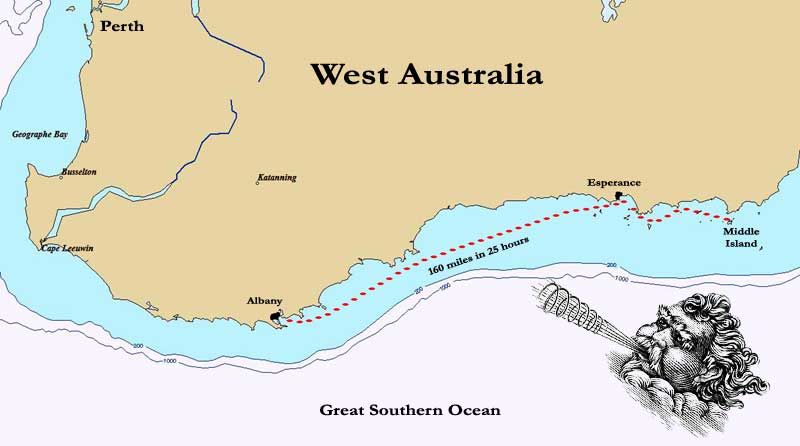
We wandered through the Recherche Archipelago, then zoomed overnight to Albany after two weeks in Esperance


The miles continue to roar past, 1,500 sailed since leaving Adelaide nine weeks ago. That's more than halfway across the huge Australian continent, and reminiscent of years gone by when we used to clock up 7 or 8,000 miles every year. This year the summer weather has been rather ordinary, being either very windy or wet, or both. We've not had many balmy days where a swim in the crystal clear waters seemed idyllic. Quite the contrary in fact. Blustery winds have made our anchorages uncomfortable, with Jude or I constantly ensuring we're not dragging our anchor. But we've had several great outings, climbed many gorgeous granite massifs and wandered through lovely heaths. But relaxing, not exactly. Been kept on our toes.

On a brighter note, in each of the major towns visited en-route we have put on a film and talk night, which have been well received by mostly full houses. Book sales of Two's a Crew keep ticking over. We just love sharing our life with so many interested folks. Young, old, boaties, armchair adventurers or lovers of nature have been attending. Its a free night's entertainment showing just how unique and diverse our Australian island continent is.

Next venue:  This Friday Night 7:30 PM at the Princess Royal Sailing Club, Albany - meals will be available

Thursday, February 17, 2011

Wild stopover at Investigator

In 1802, Matthew Flinders wrote, "Rocky Islets (Investigator Islands): low, smooth, sterile, frequented by seals"

Investigator Islands
Facing the Great Southern Ocean, this remote outpost for Nature invited investigation and we planned to anchor there overnight if conditions allowed. Lying 55 miles west of Esperance, and 15 miles from the mainland, the Investigator Islands, originally called Rocky Isles and renamed to honour Flinders' ship, are no more than two gigantic granite boulders rising out tempestuous seas.
Approaching the anchorageHard white sand bottom - but very deep
At first sight, ten miles ahead, while flying a full main and headsail poled out - filled by a gentle breeze, our first since leaving Adelaide eight weeks earlier - we were in seventh heaven. Gazing at the approaching humps gaining colour and taking shape, Jack cleaned a recently caught two-meal tuna while Jude prayed the mild swell would not have much affect in the bay trapped between the islands.

These islands are the furthest west in the Recherche Archipelago which is unsurveyed in many areas. So using the chart as an indicator, we sailed into this bay surrounded by rising granite rock, skirting the shallow patch off its head and then proceeded with caution expecting the bottom to rise suddenly. Looking about, there were no sandy beaches, just steep bare rock all around, so it wasn’t surprising that we had to sink our anchor into great depths.

Cleaning out accumulated Ribbon Grass from anchor lockerOur first sight of Sea Lions. Jude's off to retrieve her camera
Once settled, our next look about found sea-lions littering the rock slopes. Too late to row around, but we didn’t mind, in half an hour the sun would be melted gold behind black rock, and there was heaps to see from our floating home. A group of what we thought were NZ fur seals were cavorting about in the rocky gap between the two islands, their dark shapes starkly contrasting against the white breaking southern ocean swells seething with foam. Through binoculars, their dripping wet coats reflected the orange glow of the setting sun through which sea-birds were already flying home.

Sea-lions and fur seals slipped off rocks and swam beside us, hand standing under water to wave flippers, and excitedly leapt about in such perfect harmony with the sea while others raised their heads to ask ‘Who’s come to visit our island?’

Around us the world is wild, stark, menacing. While downstairs it’s warm, woodsy, cosy. The transition swift, absolute. Upstairs, orange and amber red succulents carpet pink granite massifs that form the backdrop to dark creatures lugging their slug-like bodies up slopes, or posturing, heads aloof, princely, regal, while overhead against scudding darkening grey, forked tailed terns dart, their eyes striped black – inquisitive, hanging perilously aloft on lopping fragile wings.

Life is in abundance – or is it? For an outpost of Nature our experience says there should be more. Memories of dark clouds that became seabirds are replaced by visions of a dotted presence, and sea lions as far as the eye can see replaced by peppercorns scattered here and there. Who took away God’s creatures? Was it global warming? Or did man take their food?

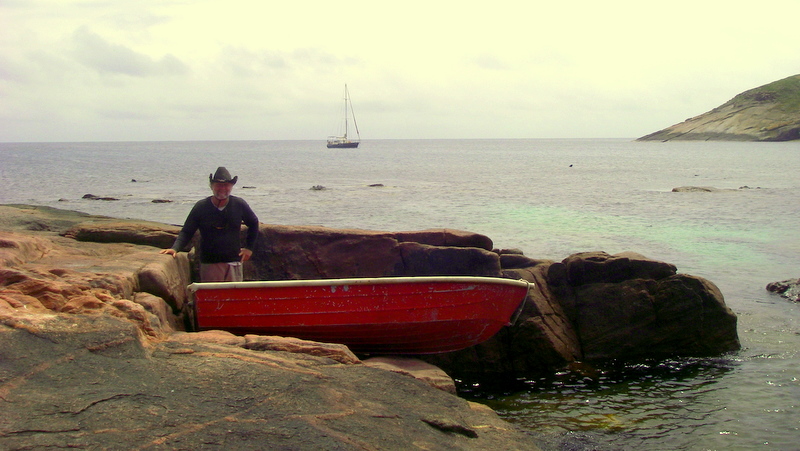
Overnight we were gently rocked to sleep, then kept alert by intensified wind gusts through the gap between the islands, and were awoken early by yelps of seal pups demanding a feed. Over our radio, the forecast is for light winds to increase after noon, already sunny patches have begun peeking through morning cloud, so we quickly moved to launch Little Red and row around for a look. Anticipating a landing, shore going gear was packed, but two attempts were aborted. Once Jack got both feet out the dinghy to stand on slippery sloping rock. He didn’t dare let go else slide into the briny. No choice but to step smartly back in. Immediately after, in perfect unison a swell swept the dinghy away. Lucky him.

This old Bull had lost had his haremThis one popped out to say HiSome just slept.

We did get ashore. Jack had seen a nick behind a large rock and chanced rowing us over submerged ones on a surge and came nicely into a perfect harbour no bigger than Little Red. Off the stern we scrambled onto a very flat, dry rock about a foot above the water then hauled Little Red up after us.

First orientation, we looked around, got our bearings, noting what’s close at hand.  Two bulls not far away were giving each other stick and their land-lumbering bodies looked as if they could cause damage. Not a good idea to catch one by surprise. During our sortie, with some apprehension we carefully checked behind each rock as we passed. Three or four were curious, or territorial enough to have us back away and allow them their space. And while one mum was taking time off to bathe in an elevated pool, we surprised her pup, unintentionally, and he screamed a frightened yelp from a ledge away from her. Both looked very healthy animals and we hoped they’d stay that way. This is something which plays on our minds, the going ashore on these isolated islands rarely stepped upon.

This mother is taking a beauty bathSnoozing oblivious to us


Crested Terns - Not as many as we expected - whose taking their food?


Apart from sitting atop the island’s summit to watch Bridled Terns soaring about we touched little and did nothing that could interfere with the islands’ integrity. By sitting still, the terns were soon landing beside us to shelter in the overhang. How great to see them at eye-level just a few feet in front, or on the wind floating like feathers. Down nearer sea-level a flock of Crested-Terns preferred to rest on the smooth granite, and in the far distance a pair of sea-eagles soared above the island on the upswept wind. While watching, one swooped and caught a tern. Then it flew off, each talon clutching a wing, its prey facing forward making it look just like a bi-plane.

Below the islands’ granite tops, in shelter from the worst weather, a thick mat of orange through amber to yellow, pink and green grape-like succulents abounded in delicate purple flowers. These islands have no other vegetation.


So lovely and unique, and filled with the majesty of nature, we spent the full day observing the other creatures live their life, which confirmed yet again that they do pretty much the same as us. Care for their young, find food, investigate life. What joy that brought us. We are one, the wild ones and us. Each wanting the same thing. A future for our kids, and time to observe and enjoy this magical creation.


During winter gales, the sea washes straight over this low shelf. Jude would be in grave danger there.


There is no soil on these rocks, no shrubs grow, no trees, only a colourful succulent can withstand such harsh conditions. Here an old bull, probably another outcast, has taken residence up near the top of the hill.

Surrounded by nature makes us happyEarly morning departure after two days in the wild kingdom

Wednesday, January 26, 2011

Feeling True Blue
Australia Day assent up Flinders Peak on Middle Island

Flinders Peak (185 M)  from Goose Island

Clearly Flinders Peak beckoned us. After all, this was Australia Day and she was shining delightfully in the sunlight, bold granite faces of ochres and greys waiting to be walked on. Wanting to be explored, like it had when Flinders and his men climbed to the top to get a better view of the layout of this great archipelago. A view that would aid Flinders navigate eastward.
Just that morning we’d shifted Banyandah into this bay, the closest and biggest to a starting point for our climb, where we’d carefully positioned our anchor to be as close to the shore as we dared, and be out the easterly swell crossing the bay. During the previous night, when parked off Goose Island we’d had northerly winds as expected until mid-morning, causing a rolling sea, but nothing more than uncomfortable, until late morning when it changed to the east and we moved here.
Clearly I have to be the most fortunate person in the world. I say this because who else could possibly be preparing a daypack with water, first aid, a little food so to be about to climb a little known peak named after Matthew Flinders on Australia Day.  Big hugs from Jude


Pink Lake behind our first anchorageAerial View


Mermaids tits rising out the mist


Tuesday, January 25, 2011

Chasing a wild goose

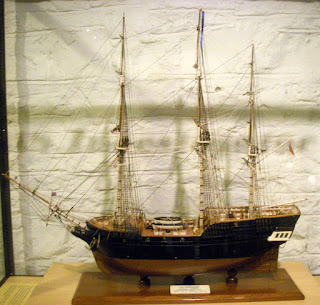
HMS The Investigator

In flickering candlelight, the boatswain’s mate wet the delirious man’s brow as he lay shouting “Mary, Mary, I love you.” Then with a sigh the man’s head slipped sideways into silence. From between darkened decks, a sickly figure ambled forward resplendent in gold braid. “How’s the boatswain,” he wheezed. The mate simply shook his head.

In the dim light before dawn, Charles Douglas, of His Majesties Ship The Investigator was sewn into a piece of old sail, loaded into a long boat then hauled onto the low slopes of the recently named Goose Island. There, before an assembly of his shipmates, Captain Flinders read the eulogy. “Charles Douglas was an honest man who served God and his country. He will not be forgotten.” The year was 1803.

“Hey Jude,” I called forward from my writing desk. “The Investigator’s bosun is buried on Goose Island.”

She joined me in the cockpit and together we looked across the bay. “Any idea where?” she asked.

Overnight, cool air from Antarctica had driven away the heat haze of several days, and now the sand hills surrounding Cape Arid stood crisp white against unblemished sea and sky. On our left, rising sharply against a tiffany sky, Flinders Peak dribbled old blood streaked with sunshine. Between the two, Goose Island emerged, a low emerald from a sheet of sapphire.

“Where,” I laughed. “All the guidebook says is his grave was inscribed Charles Douglas HMS Investigator May 18, 1803 when discovered in 1999.


Instinctively our eyes searched that mile long island as I added, “It doesn’t say where. But my guess is it’ll be close to a landing and probably face the rising sun – that’s where I’d like to be laid to rest.”

“Shall we go and look?” Jude softly asked like a schoolgirl seeking a treat.

“Sure! But first let’s shift Banyandah. What a thrill it’ll be to touch something from The Investigator.”
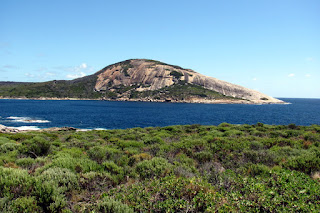
Beyond the limestone cliffs that ran towards Middle Island, a finger of white sand sparkled beneath bold Caribbean blue, and where sand met sea, a picturesque limestone arch rose. Jude became radiant, a distant memory dancing in her eyes. “Reminds me of Ventotene,” she trilled, and I remembered making love on just such a beach, hidden inside just such a cave while the sea lapped our feet.

“I’ll row now,” she declared. “Those spooky caves and limestone teeth will look great on film.”

So we switched places, and while she pulled the oars, I watched her breasts rise and firm, and that sent my mind back to the cave.

Rounding the craggy headland a perfect white beach ran a hundred metres before reaching the channel between the two islands. Assisted by a low surge we grounded then quickly dragged our dinghy up the hard sand, where I immediately documented our landing by panning from the beach through the archway to Banyandah tugging at her anchor.


“He won’t be buried here,” I declared, looking to Jude brushing sand from her toes, her socks and boots standing ready. “The grave wasn’t discovered for nearly 200 years, so it won’t be next to the only decent landing site.”

D’entrecasteau first recorded these islands in 1792 naming the archipelago after his ship, The Recherche. Later explorers mostly avoided the area because it is littered with 105 islands, and over 1200 "obstacles to shipping" jutting out the sea.  It’s far flung from mankind, without any roads near. No need. The ground is sand or rock; no resources of note. It’s a place for Earth’s other creatures, and boy, do they abound in variety. Each year  flocks of seabirds come here to reproduce. They live underground in burrows dug by beak and webbed feet, and each year they return to the exact same hole.

Flinders wrote of the sky being turned black for hours by their passing millions. However, today, though man doesn’t hunt these creatures anymore, their numbers are greatly reduced. Why? Because we take their food. We harvest whole schools of pilchards at a time – to feed our cats, or the tuna we capture and keep in nets. It might help if we remember that every form of Earth life is connected. What man takes makes another suffer.

Picking our way carefully, we wended past bushy tea-tree and sharp scrub, towards a rock shelf rising up the weather side, avoiding mutton bird burrows that spread ahead like a minefield. Between them on the bare earth we saw tiny shuffling footprints of little blue penguins that also live on the island. Surprising us next; we found large areas of round spoor, and prayed it came from small marsupials. But shortly were disappointed to catch sight of a small rabbit bobbing away.

“Pretty one, that,” Jude exclaimed.

I’m sure she was thinking of her childhood pet, because although this one had lovely black fur tinged rusty gold, we both knew it was a disaster. Memories of totally denuded islands came to mind.

“Wonder how they got here,” I mused, shaking my head. They’re so destructive, firstly destroying the moist refugia around rocky outcrops causing the decline of medium sized mammals and then as their numbers increase, they devour all plant life. Like humans nibbling away, first along the edges of wilderness, little bites till there’s none left.

Along that shelf we travelled the weatherside, watching glorious blue sea bursting white on rocks while traversing higher in the direction of an eagle’s nest. Then as we crested the ridge, the nest became an immense rock cairn atop the island’s peak. Jude added our stone, having to hitch herself up on a big stone to reach its top.

“I see what you meant,” Jude said. “I agree, Charles would more likely be interned on that ridge there, or that one,” she said pointing to two fingers running parallel in line towards our ship. “The Investigator would have parked just a bit further out from us.”

I agreed but suggested, “If you like, let’s first explore that cave. See? High up that rock mass at the far end, and then we’ll search for Charles on the way back.”

Exploring a far distant island turned us retirees into children by energising our spirits. The air carried more vigour; our eyes noticed more detail, our minds asked questions, and we soon forgot our aches.
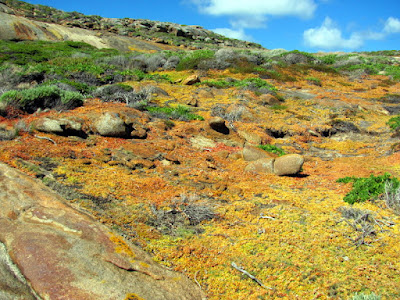


The cave proved no more than an overhang popular with sea birds. Fish bones littered the earth among a white carpet of excrement and shattered sea shells. But around it and spreading up a shallow valley was a carpet of gorgeous succulents the colour of fire at dawn. Polyps, billions of them. And while filming this grandeur, Jude with her backpack like the hunchback of Notre Dame frightened a massive wedge tail eagle into flight so that the parade of colours and action through my lens made me gasp.

When only three fingers of sky separated sun from sea, it told us to hurry or spend the night surrounded by noisy penguins. Heading home through the low slopes of brush, every step brought new hope of stumbling across Charles. Over and over I imagined how I’d react to finding a direct link to The Investigator, while in my head ran the constant chant of “I’ve found it!”

What would I first see? A headstone? Probably not. More likely a neat pile of stones. The island had had two hundred years of growth. Those trees nearby were not here then. And Charles could lay at rest under them, or under any of the thicker growth.


Finding Charles became hot, sticky work, hopeful, then disappointed. Finding a metal stake set my heart racing. It led to another by some trees and the words of discovery were ready to fly from my lips. But all I found were half buried plastic bins being used for some sort of scientific experiment similar to those we’d seen on other islands. Catching rats I suppose. 

Exhausted, sweaty, thinking of a shower and cold beer, totally spent from our day’s excitement surrounded by Nature’s beauty, we began talking of rowing home. Finding Charles may not have been meant to be. Rest in peace Charles Douglas.

A humorous footnote to this adventure came when we emerged from our communications vacuum here at Cape Le Grand, 25 km short of Esperance. Now able to connect to the worldwide net again we did a search for Charles. He wasn’t easy to find.

He had died of dysentery on board The Investigator as they approached Middle Island and Flinders had named the island nearest them in his honour and we had seen Douglas Island when we sailed away. But his final resting place? Aaah! Our guidebook had it wrong! It was May 1803, the winter seas big, and Flinders’ crew were sick and weak. Even the captain couldn’t land on Goose Island, so Charles was interned behind the third bay of Middle Island. And you’ll be amused to read that we had parked right by him the following day, and had walked within cooee of his grave during our jaunt up Flinders Peak on Australia Day….. What a marvellous wild goose chase!